What it measures
OTIF (On-Time In-Full) measures, for each customer order, whether it was delivered on time and in full at customer receipt. The pack breaks this ratio down by customer, site, product family, and channel, with gap-to-target and a 24-month rolling history.
OTIF measures service failures after delivery; the financial consequence, such as a retailer penalty or lost sale, is already locked in before the score is calculated and reported.
Business impact
- Increased 'chaos tax' from emergency production runs, premium freight spend, and customer service overtime to manage the fallout of broken delivery promises.
- Sustained underperformance triggers a formal retailer service improvement plan — the structured final warning before range removal and delisting.
Formula
(Order lines delivered OTIF / Total order lines) x 100Grain
One row per customer sales order line — customer × product × site × requested delivery date
Inside the Implementation Pack
A preview of what's actually built for this KPI — extracted from the real Implementation Pack, not a mockup.
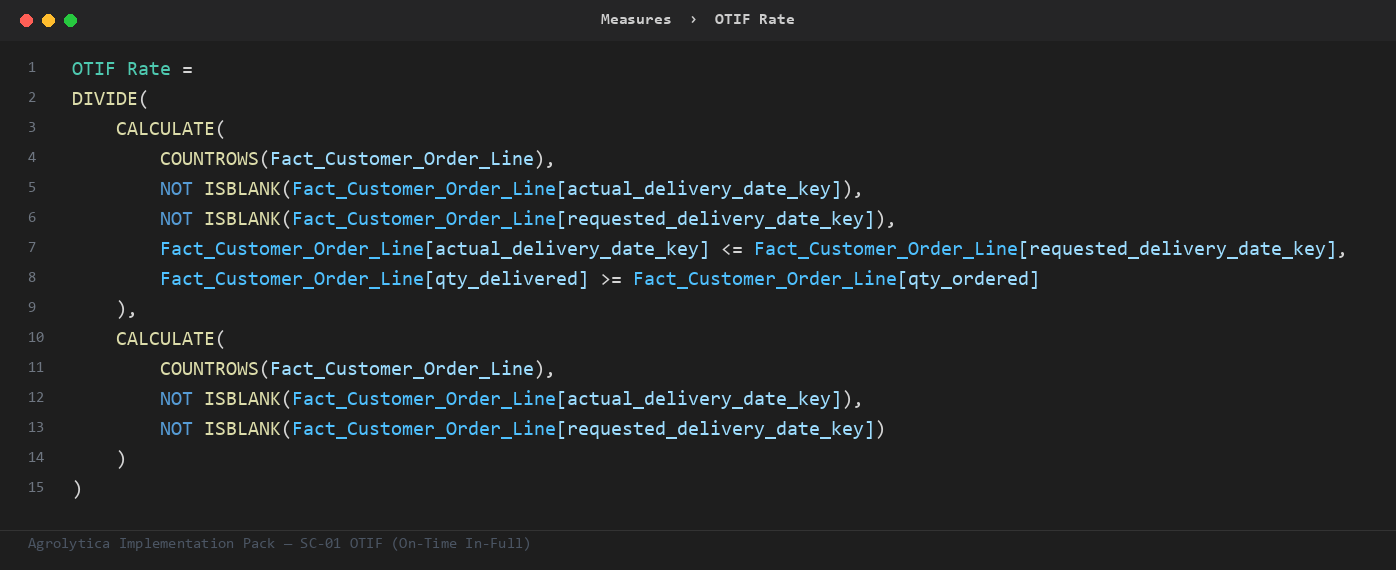
This is the primary ratio the pack's other measures build on — trend, rank, and period-comparison variants, all on Fact_Customer_Order_Line. It guards against missing dates and values with NOT ISBLANK checks.
Fact_Customer_Order_Line— 7 mandatory columns — qty ordered, requested delivery date key, ...Dim_Customer— key + nameDim_Product— key + nameDim_Site— key + nameDim_Date— Auto-generated calendar table — no customer data required
Full field-by-field data contract, in 4 SQL dialects (SQL Server, Snowflake, Databricks, BigQuery), ships in the pack.
| Target | 0.98 — performance considered compliant at or above this line |
| Warning | 0.95 — amber alert — triggers a review |
Both live in one Excel tab — change them, refresh the report, done. No DAX editing needed.
Everything you need to build OTIF (On-Time In-Full) in Power BI — dimensional model, DAX measures, SQL views, and a food-industry demo dataset.